
Computational Thinking, and how to make it common sense
Jeanette Wing, a computer science researcher from Columbia University deifned computational thinking as “a way of solving problems, designing systems, and understanding human behavior by drawing on the concepts of computer science.” When we look at this through a learning and teaching lens, we think of problem solving. How will my students learn to break down this big problem, and find ways to come up with a solution? In a math or science sense, I believe this to be a vital skill we have to equip our students with. In math, we see it regulary. We see it with A + B = C or more advanced with those classic word problems where someone needs to build a chicken coop of a certain area with a certain budget.
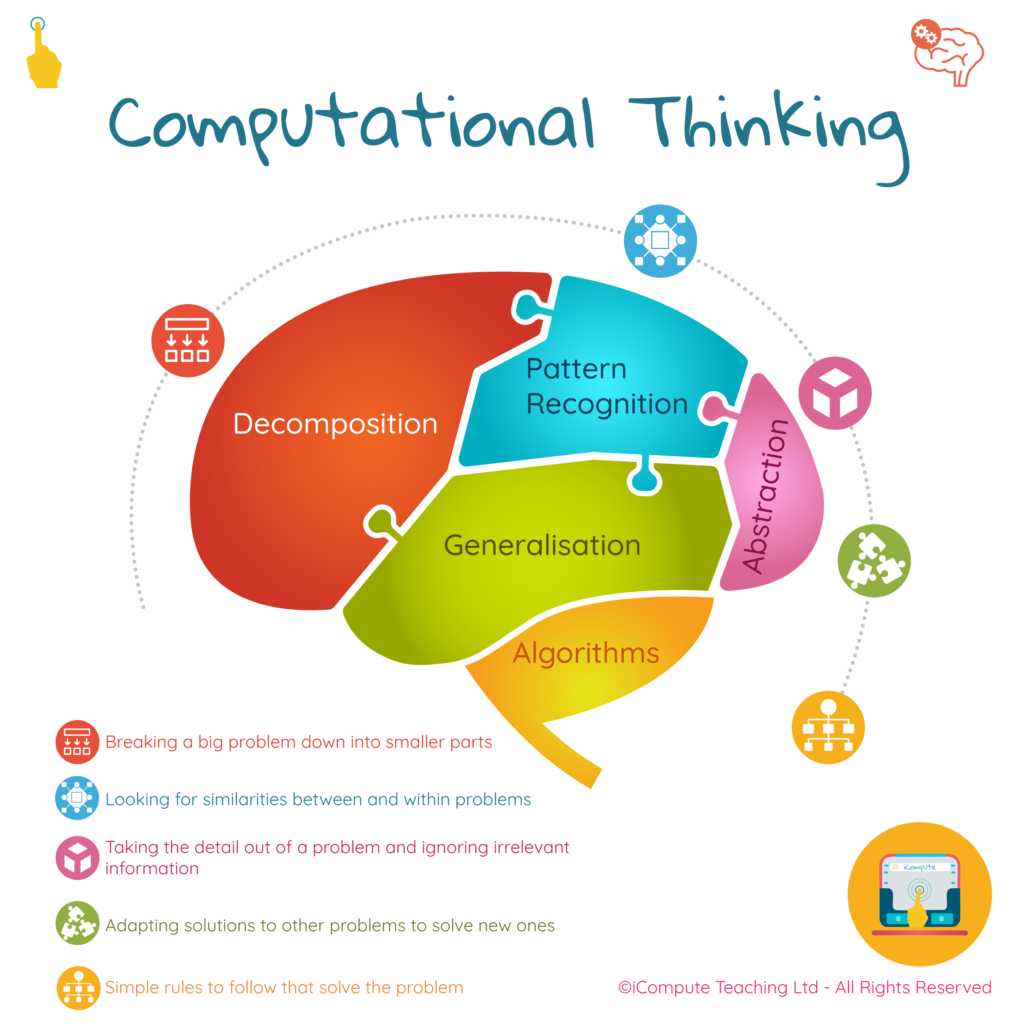
We ask students to do all parts of computational thinking, sometimes without defining it or being intentional. Myself, I believe in the intentional learning and explaining of what this process is. Explaining to my classroom that we are our first step should be breaking down problems, looking for patterns, we are seeking to outline irrelevant information, and solving for solutions that can be used broadly.
I can see this as a useful 4-step process to outline to classrooms, even have it up on the board as a checklist. Let’s take a grade 9 science class as an exmaple: I can see this process being useful in a dilution lab, test taking skills, or learning concepts such as mitosis and meiosis where there are patterns.
As someone who is not well-versed in computer programming (except the infinite hours I spent in the computer lab during my undergrad trying to run code to analyze thousands of oceanic data points and samples), jumping into an activity such as the Flappy Birds allowed me to see overlap between computer logical reasoning and problem solving.

In reality, coding games like this one demonstrate to students that thinking and problem solving is a step by step process. We can’t zoom out and just solve a problem in one step. We need to deconstruct, analyze, seek patterns, and go from there.
This leads into gamifying learning. I’m all for making learning engaging, as long as it doesn’t damage the integrity of the course or material. Some subjects thrive with games, where engagement increases. For these, I think of coding and biology topics where simulations are masked as games to depict topics such a gene flow, evolution, predator-prey relationships. A cool game I came across is the Predator vs. Prey game from the Smithsonian2. It allows students to play in a two-person simulator where one is the predator and one is the prey. While one is searching for a mate, the other is hunting for food, depicting how ecosystem ecology is so complex and a lack of mates affects predators, and vice versa!
Some things that I still need to ponder …
While gamifying is exciting, I am always thinking of the time is takes for teachers to prep for these games. This is something to keep in mind. Another thing I am still thinking about is screentime, accessibility of games, and accessibility to tech. One of my peers made a good point during our class saying that school is one place where students can be mandated to be off of their devices, and maybe sticking to old-school games is best. I wonder if games have accessibility modes, or if as teachers we will be spending time finding games, only to have to double our search time to find accessible alternatives. And finally, what about access to tech. Most schools do not have a 1:1 ratio of laptops to students. So the lessons have to be planned around when the chromebook cart can be in your classroom, and hopefully you’ve covered the material you want to before that day comes.
I’m really looking forward to encorporating computational learning authentically in my classrooms, and incorporating games that can enhance learning!